A recurring topic in our course has been the United States' shift from isolationism to the internationalism represented by the Marshall Plan and Bretton Woods.
The shift in public opinion about America's proper place in the world is perhaps best exemplified by Henry Luce, publisher of Time Magazine during WWII, who in 1941 exhorted President Franklin Roosevelt and policymakers to pursue the "first great American Century." Internationalists such as Luce believed that the US should use its economic and military might to promote democracy and act as the world's Good Samaritan.
The first American Century petered out in the 1970s as US growth slowed and the Soviet Union reached military parity, but it was temporarily resurrected by the fall of the Soviet Union in 1991. Currently, the great American international project seems to have hit another bump in the road with new economic difficulties, mixed success (at best) in two wars of choice, and serious questions about whether the US can afford prolonged military dominance.
Richard N. Haass, for one, is more optimistic. The president of the Council on Foreign Relations argues that, despite recent troubles, it's time the US pursue the second American Century. American military might is still unmatched while our economy remains strong (if not necessarily as strong as we'd like). While we first have to get our ducks in a row at home, Haass believes we can once again serve as a beacon to the world by establishing a global order of cooperation that promotes international law and solves transnational problems such as global warming.
Read his piece and share your thoughts for participation credit. Do you agree with his assessment that it's possible? Whether or not it's possible, is this something the US should pursue?
Course blog for the International Political Economy class at Rhodes College
Showing posts with label Outside Learning. Show all posts
Sunday, April 28, 2013
Tuesday, March 26, 2013
PBS Companions to "Inside the Meltdown"
Today we watched a Frontline documentary about the 2008 financial crisis. There are two strong companion pieces to "Inside the Meltdown."
"The Warning", sort of a prequel, champions a little-known woman (Brooksley Born) who chaired a little known regulatory agency (the Commodity Futures Trading Commission) and sounded an early (and ultimately unheeded) warning that trade in unregulated securities could seriously harm the US economy.
"Breaking the Bank," is the sequel. It focuses predominantly on how large banks struggled with the shock waves of the financial crisis and subsequent bailout.
You'll probably notice a bit more of a bias in the first one, but it addresses two major themes of our course: 1) what is the appropriate balance of state-market economic activity, and 2) how much of an invisible hand is there when the state (via the Fed) essentially sets the terms of economic intercourse? The second documentary overlaps a lot of today's story and takes a more practical look at government involvement in the Bank of America / Merrill Lynch merger.
You can watch both documentaries (and re-watch "Inside the Meltdown") by clicking on the links above. Those of you who would like to earn some participation points can watch a segment, discuss how it relates to class learning, and share your thoughts: two points for initial comments, one point for replies to other students.
Friday, March 1, 2013
Who Owns Your Beer?
For participation credit, share your thoughts and feelings about the documentary, Beer Wars (available on Netflix Streaming), and what it says to you about the proper relationship between government power and the products you buy.
In related news, Professor Phillip Howard at Michigan State University designed a fantastic infographic illustrating consolidation in the beer industry. Who owns your (assuming you are of drinking age) favorite brand? Double click on the image below to zoom in and explore.
Related: An historical political economy explanation for America's obsession with light beer.
In related news, Professor Phillip Howard at Michigan State University designed a fantastic infographic illustrating consolidation in the beer industry. Who owns your (assuming you are of drinking age) favorite brand? Double click on the image below to zoom in and explore.
Related: An historical political economy explanation for America's obsession with light beer.
Tuesday, February 5, 2013
The Economist's Interactive Big Mac Index
Check out the Interactive Big Mac Index that we talked about in class, courtesy of The Economist.
The page lets you play with the variables a bit. You can even download the time-series data in Excel format if you want to play with it.
For participation credit, share why you think certain currencies are over- or undervalued, why you might think the Big Mac Index is not a proper measure of currency valuation, or why you think currency valuations may fluctuate over time.
The page lets you play with the variables a bit. You can even download the time-series data in Excel format if you want to play with it.
For participation credit, share why you think certain currencies are over- or undervalued, why you might think the Big Mac Index is not a proper measure of currency valuation, or why you think currency valuations may fluctuate over time.
Sunday, January 27, 2013
Starbucks, United Kingdom Clash over Taxes
MarketWatch has the story:
The puzzle: Starbucks is a US-based multinational corporation that does a lot of business in the UK (and everywhere people are willing to pay $5 for coffee with milk). The UK would like to tax Starbucks' earnings (as most states do with most businesses). Starbucks, if it chooses to do so, can simply move its capital out of UK if it doesn't like the deal that Britain offers the multinational.
So, what is a state to do? How should the UK respond to Starbucks' threat to cease new investment if they are forced to pay higher taxes? Read the article and share your well-reasoned thoughts in the comments for participation points.
...Mr. Cameron said companies must "wake up and smell the coffee" over tax avoidance... [Starbucks] has been criticized for not paying enough corporation tax in the U.K. Reports said Starbucks could suspend 100 million pounds ($158 million) investment earmarked for new branches in the U.K. due to the perceived slight...This relates to a quandary that we've been discussing in class: mobile capital and the incapacity of states to capture it in a global economy.
The puzzle: Starbucks is a US-based multinational corporation that does a lot of business in the UK (and everywhere people are willing to pay $5 for coffee with milk). The UK would like to tax Starbucks' earnings (as most states do with most businesses). Starbucks, if it chooses to do so, can simply move its capital out of UK if it doesn't like the deal that Britain offers the multinational.
So, what is a state to do? How should the UK respond to Starbucks' threat to cease new investment if they are forced to pay higher taxes? Read the article and share your well-reasoned thoughts in the comments for participation points.
Monday, January 14, 2013
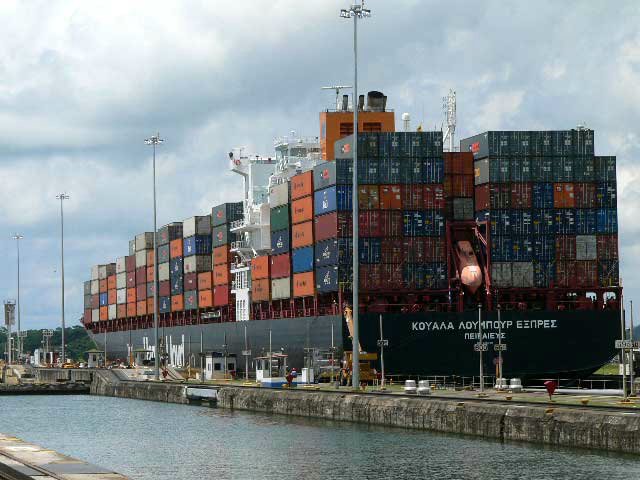
Public, Private Money Drives Innovation in Naval Commerce
| Photo credit: Panama Canal History Museum |
A global public-private alliance is expanding the Panama canal to allow larger container ships to pass through. This will permit these massive ships arriving from Asia to call on ports on the US East Coast. At the moment, they dock on the West Coast and the cargo is shipped overland by road and rail.
This raises a question: if this commerce produces so much wealth, why should governments spend taxpayer money on these projects? Couldn't we just let the market take care of it? And if the market won't pay for it, is it something that taxpayers should pay for anyway?
Read the article, share your opinion and explain your answer for participation credit.
Subscribe to:
Posts (Atom)